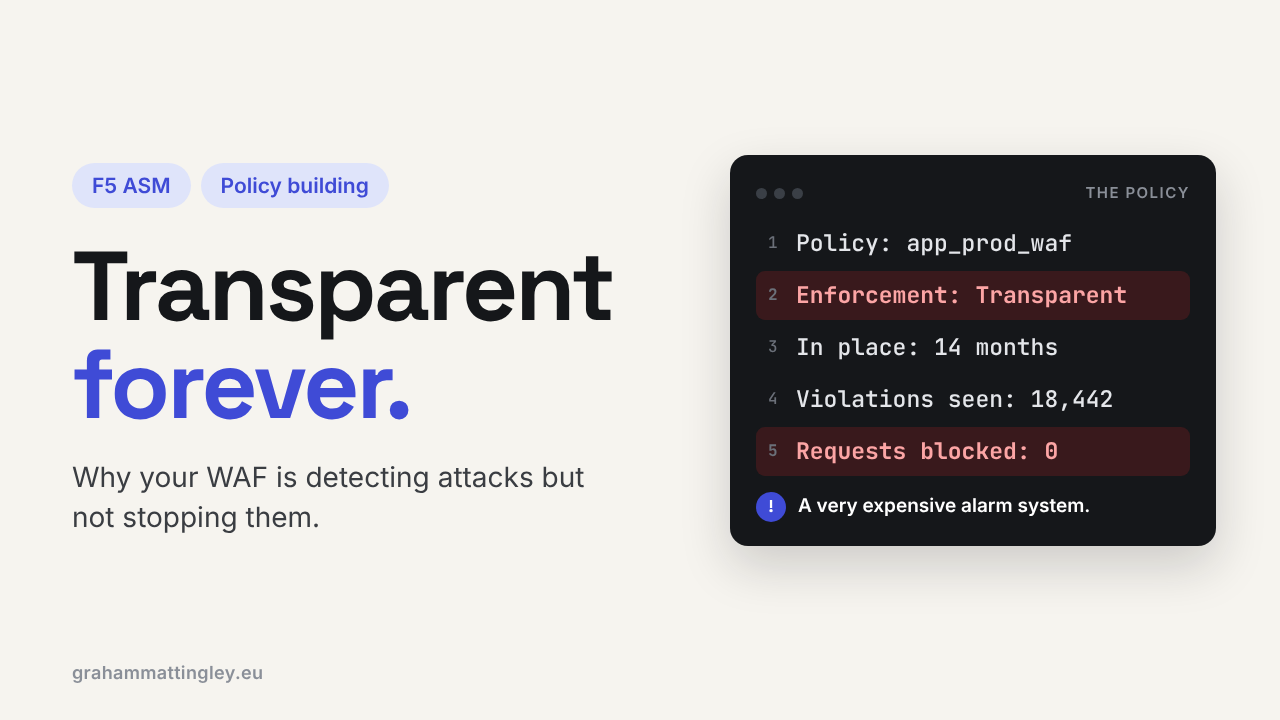
Why Blocking Mode Isn’t Working: The Hidden Risk of “Transparent Forever”
Jun 09, 2026Transparent mode is not the problem. Forgetting to move beyond it is.
1. Transparent mode is meant to reduce deployment risk
You use transparent mode while learning traffic, reviewing violations, tuning signatures, and understanding false positives.
When building a policy, the Enforcement Readiness Period should not become an open-ended delay. A target date for moving the policy towards blocking should be set early, often after three or four ERP cycles, depending on the application, traffic volume, and review process. It is a good idea to publish the "block mode date" on day one of the policy deployment, if possible.
In my training, I show you how to use transparent mode properly, without letting it become the permanent state of the policy.
2. But the transparent mode does not stop the attack
The policy may detect SQL injection, XSS, bad parameters, evasion techniques, or protocol violations, but the request can still reach the application.
Policies are not usually left in transparent mode as a deliberate monitoring strategy. They are more often left there because the team is worried about false positives and the possible impact of moving to blocking mode.
In my training, I test this behaviour live so you can see the difference between detecting an attack and actually stopping it.
3. “Block it later” often becomes permanent
Teams get nervous about false positives, application owners lose interest, and nobody owns the final move to blocking.
The policy is forgotten, and the next time it gets serious attention is often when the organisation becomes aware of a problem, or when a penetration test shows that attacks are still reaching the application.
In my training, I show you how to move from intention to action, so blocking becomes a controlled step rather than something postponed forever.
4. A transparent policy can create false confidence
Dashboards show violations. Reports show activity. ASM looks deployed.
But the application may still be exposed.
This can create a misleading view of the application’s security posture. The organisation may be able to say it has a WAF deployed, but that does not mean the WAF is actively protecting the application.
In my training, I separate visibility from protection, so you understand what ASM is showing you and what it is actually enforcing.
5. Blocking needs a controlled process
Blocking should not mean turning everything on and hoping for the best.
A proper process means reviewing violations, tuning noise, deciding what is safe to block, testing the impact, and then gradually moving protections into blocking.
Blocking mode can often be enabled sooner than teams think. False positive issues can be handled carefully in blocking mode without breaking the application. F5 ASM provides several ways to manage enforcement, including staging, learning, alarm-only violations, selective blocking, and policy tuning while the application remains protected.
If your ASM policy has been transparent for months, you may not have a WAF deployment. You may have a very expensive alarm system.
In my training, I take you through that controlled process, including how to decide what can be blocked safely and what still needs investigation.
If your ASM policy has been transparent for months, you may not have a WAF deployment. You may have a very expensive alarm system.
Get F5 in Practice by email
One practical F5 insight at a time, written by me from work I've actually done.
Your email stays with me. It is never shared.
No spam. I will never sell your information, for any reason.